
Sometimes you need to revisit the foundational books of your youth just to see how you both have aged.
Listening to the audiobook of Arthur C. Clarke’s Rendezvous with Rama felt a little like traveling back in time to the 1970s, the last time I read that classic tale. I wondered how well it would compare to my memories. I wondered if it would hold up. Of all the old white guys of early science fiction, would Arthur C. Clarke reveal himself to be better or worse after 50 years?
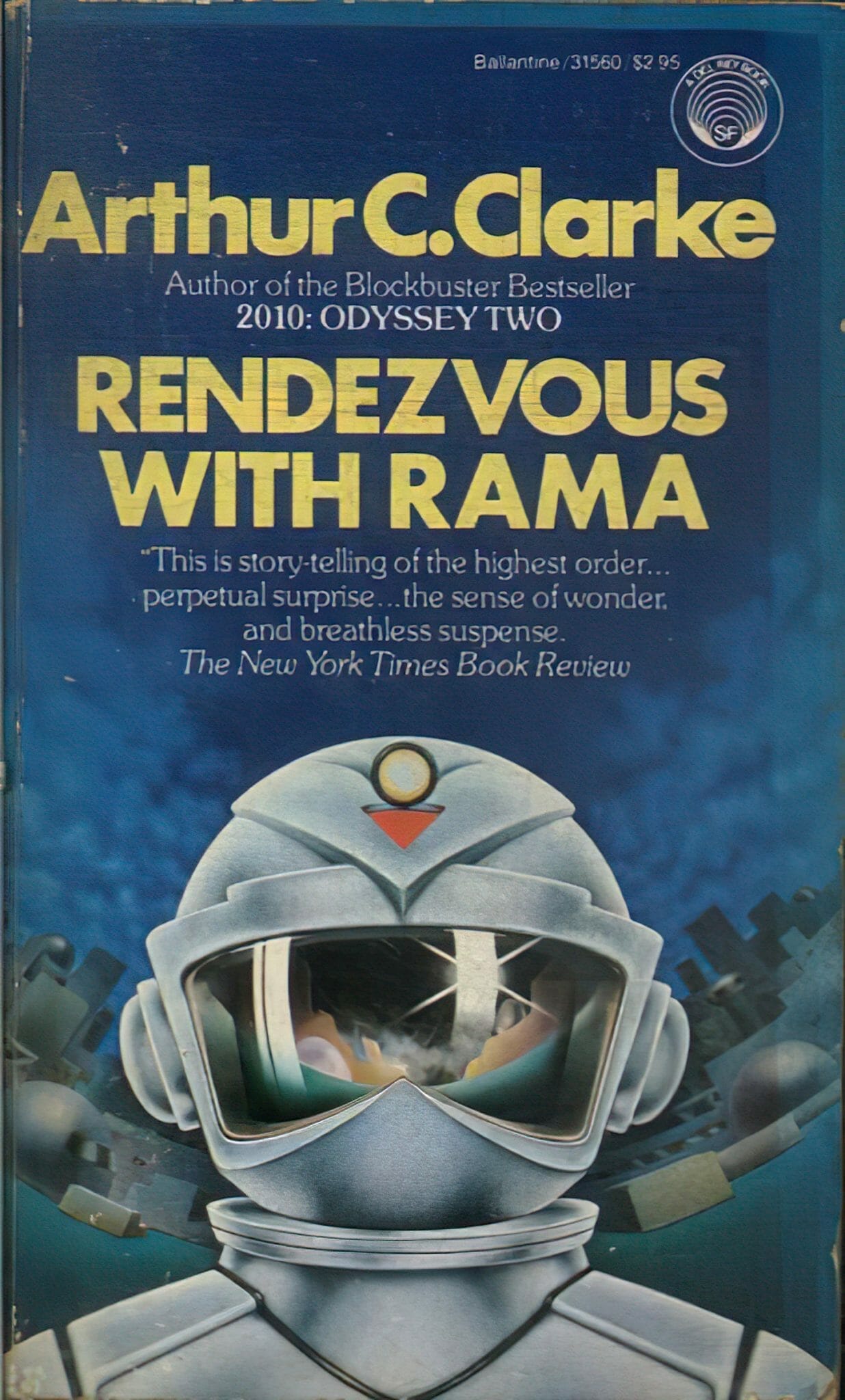
The cover
This is, as far as I can recall, the cover of the paperback I read back in the mid to late 1970s. A lot of old-school airbrush work going on, but not a lot of detail about the book. Clarke’s name is doing the selling here.
Rama has a simple story. When an object emerges from the Oort Cloud headed sunward, it takes a while for scientists to recognize that it’s not a comet nor other natural body—it is a massive spacecraft. The nearest human vessel is diverted to make contact and to report their findings. What they find is a featureless, enclosed fifty-kilometer-long cylinder with a radius of 20 kilometers, rotating such that anything on its inner surface would experience half of Earth’s gravity from centrifugal force—an immense surface area for any inhabitants.
The crew and her captain dock with the craft and explore the artifact as it continues to race toward our sun. What they find is both fascinating and frustrating, as though they’d been assigned to investigate a haunted house.
This book is full of ideas, as all Clarke’s books are. Of all the early writers of science fiction, Clarke is the most like an engineer. He finds solutions to humanity’s big problems and then writes about the science and technology we’d need to master to achieve them. It was a quality of his work that entranced me as a teenager, and it still stands as his greatest talent.
But the ideas here are now old ideas.
The idea of a gigantic spinning cylinder serving as a habitat has been explored in numerous books, movies, and video games. Clarke gets credit for being the first to explore the concept, but the concept is no longer so novel that it can support a story alone. Without that central pillar of intellectual curiosity, the book has little else to sustain its readers’ interest. Clarke’ doesn’t provide a cast of characters with any real depth of human goals, motivation, or conflict. There are no human emotions to latch onto because Clarke depends on the gee-whiz science to carry the story.
To make matters worse, in the characterization department, Clarke was not immune from sexist depictions of female characters. Descriptions of women on the ship’s crew as distractions because of the effects of zero-gravity on the movement of their breasts predate the sports bra—but they come across as lewd and pervy. I get it. I was born into that era. My mother couldn’t get a credit card in her own name without her husband’s permission. Those were the times. But they were not good times. Clarke’s exceedingly male cast cries out for a feminist makeover.
I listened to this as an audiobook and I should say a few words on that production. It was published and produced by Audible Studios, and it was sort of terrible. The narration was flat, monotonous, and robotic. This certainly didn’t help the 50-year-old story. Even worse than the narration was an introduction by Robert J. Sawyer, who pronounced Rama as if it rhymed with Alabama.
I’m giving Rendezvous with Rama five stars for nostalgia and for its huge ideas, and I’m subtracting one for ancient sexism and Audible’s less than stellar audiobook production.
⭐️⭐️⭐️⭐️★
Rendezvous With Rama
Arthur C. Clarke
Publication Date: June 1973
Publisher: Gollancz